
What I Learned Wearing a Continuous Glucose Monitor (CGM)

A few years ago, if someone had told me I’d become fascinated by blood sugar patterns, I probably would have assumed they were talking about diabetes management.
But after researching the connection between our nervous system and our blood sugar patterns and then wearing a Continuous Glucose Monitor (CGM) myself, I quickly realized these devices can tell us so much more than whether someone is diabetic or pre-diabetic.
They can offer insight into:
stress physiology
nervous system activation
sleep quality
exercise recovery
meal balance
energy crashes
emotional overwhelm
under-eating
cravings
metabolic flexibility
At HartsSpace, I use CGMs through a functional nutrition and mind-body lens.
Not to create obsession. In fact, I screen clients before CGM usage because there are cases where the information could be counterproductive.
My main focus with using CGMs is to help people become more aware of their bodies with curiosity and compassion.
I've watched CGM data help people connect to their nervous system and mood fluctuations in such profound ways. It can be an incredible tool to help get us back into our bodies and understand why and how they are experiencing the world. It can be so hard to connect how your lunch, for example, impacts your mood 2 hours later OR how intermittent fasting/skipping breakfast is putting a body into a higher stress mode, causing glucose patterns to be wonky all day, even before bringing food into the picture!
In this post, I’ll walk you through:
what a CGM is
how they work
how to get started
what wearing one actually feels like
what surprised me most from my own data
and how stress, sleep, food, and movement all influenced my glucose patterns.
What Is a CGM?

A Continuous Glucose Monitor (CGM) is a small wearable sensor that tracks glucose levels throughout the day and night.
Instead of getting one isolated blood sugar reading, CGMs allow you to see patterns over time:
after meals
during sleep
during stressful situations
during exercise
while fasting
and even during emotionally activating moments.
The sensor sits just under the skin and sends data to an app on your phone. (Consumer Guide)
The CGM I Personally Use
I personally use and recommend the Stelo by Dexcom.
Why I like it:
no prescription required
easy app setup
relatively affordable compared to traditional CGMs
beginner-friendly
comfortable to wear
integrates well into daily life
can sync with my Dexcom provider portal so I can easily see client data and review it in session with my clients
The Stelo sensor lasts up to 15 days per sensor and pairs with the Stelo app on your phone. (Consumer Guide). You can get a 4-week supply for $99.
What It’s Like to Put One On
This was honestly one of the biggest questions I had before trying one.
And surprisingly? It was much easier and less painful than I expected.
The sensor is applied to the back of the upper arm using an applicator device. The app walks you through setup step-by-step. (Stelo)
My Experience:
I really built it up in my head that it was going to be painful to put on, but I truly barely felt it. If anything, taking it off is the worst part, simply due to the tape/adhesive you put on to keep the device secure.
After that, I would forget I was even wearing it at times. Except for when:
My toddler would grab it every time I was changing his diaper
I was changing my shirt (the device can get caught on the shirt sleeve and pull)
The sensor has a ~30-minute warmup period before readings begin. And sometimes that initial day of data can look funky so I try not to read into that day too much. (Consumer Guide)
Setting Up the App
The setup process is fairly straightforward:
Download the Stelo app
Create an account
Pair the sensor
Apply the sensor
Wait for the warmup period
The app allows you to:
view glucose trends
log meals
track exercise
monitor overnight patterns
observe stress responses
share your data via a Dexcom provider portal (clinic code: jwchese0)
(Stelo)
You can even begin noticing how things like:
poor sleep
skipped meals
caffeine
intense workouts
emotional stress
impact your glucose stability.
One of my favorite features of the the tracking is you can take photos of your food, and the app will write out a description of the food alongside the photo. As a provider, this is helpful for me to see because it shows me your full meal composition and easy things to shift or add. It also allows me to see the timing of your meals. For my own brain, this is much easier for me to work with, rather than just numbers and macro ratios.
I want people to begin to visualize their meals and having a visual to actually work off of is great for this!
The app will also pair to your smart watch (or whatever smart device you use) and track exercise and sleep in the app as well.
What My Data Taught Me
I started this around March 12th, when I was already pretty dialed into a gym and running routine, pretty aware of my sleep (or lack thereof), and feeling pretty comfortable around where I was at in my nutrition and relationship with food. But I was still dealing with mood, anxiety, and random low days, which, I could attribute to hormones, but, I figured, let's see what's going on with my glucose patterns!
Probably the biggest insight OVERALL for me was that my body, my physiology, and my nervous system are still recovering from a challenging pregnancy and postpartum. I tell every postpartum client I have that it can take up to 4 years for your body to recover in terms of healing, nutrient replenishment, and nervous system balance.... But did that apply to me? Of course NOT (sarcasm). I'm almost 2 years postpartum and this experiment reminded me to have grace, focus on what truly feels supportive, and that pushing too hard can and often will backfire. So let's take a look in more detail at what I gathered in a nutshell:
Balanced Meals Felt Different

I know this. I know from studying nutrition for years now. But to see it in real time and how my body personally reacts to different foods was so helpful. And what I've seen working with clients is that certain foods can spike blood sugar that are quite surprising. Like my client who found raspberries spiked her blood sugar, even paired with a fat. Or my client that found that black coffee (no sugar) raised their blood sugar every morning (likely due to the caffeine and adrenaline triggering glucose release).
I also really noticed that, for me, fiber with meals were a game changer. Protein and fat paired with carbohydrates can be really helpful for reducing the highs and lows of glucose, but when I focused on more beans, lentils, and even psyllium, my levels were more balanced and I, in turn, felt SO MUCH more regulated.
I also noticed a HUGE reduction in cravings for sweets when eating this way. This is another common takeaway that clients will notice, that the glucose high, then low/drop, is often what triggers cravings for more sugar and refined carbohydrates.
I could go on and on about the food piece but the main takeaway is, being able to see how YOUR body and YOUR system is reacting gives us so much more insight than guessing and making assumptions. This allows us to adjust eating in a way that is less inflammatory, more balanced, and, eventually, more intuitive because it's based on your body and your experience.
Exercise Was Fascinating

My go-to for my pre-run meal has always been a bagel and cream cheese. For years! I'm a total sucker for bagels and loved this for my routine, HOWEVER, you can see above just how FAST my body burned through that meal. Maybe I got away with this in my 20's, but clearly, not now. I ate and ran about 30 minutes later. Within 15 minutes of my run, my blood sugar dropped below baseline, which definitely explains why I always feel a lull around that first mile.
My body was able to boost my glucose to sustain me but you can see where my body was really struggling between 9 and 10 AM. Then between 10 and 11, my body brought up my glucose the highest it was all day. I was not fueling myself well at all which means my body was putting in extra, extra work.
My body was in total stress mode trying to help me sustain my run. In hindsight, it's obvious now that a bagel and cream cheese likely wouldn't be an effective pre-run meal, but seeing just how impactful it was on my glucose and, by extension, my cortisol response, definitely made me rethink this strategy.
It also made me realize how stressful long runs can be on my body and moved me into doing more interval (jog then walk) strategies in my training plan so I could give my body breaks and recovery time during the run.
Here's another fun day to look at...

I got to see how my body spiked and recovered from jelly beans (note: your body is suppose to spike from something like jelly beans - but seeing how your body recovers after is the important data).
I got to see how my body responded to exercise in the evening as opposed to morning. How better nourishment earlier in the day made my exercise much manageable, stress wise. Also, how my body reacts to strength training vs. longer runs.
All of this is just good information and curiosity! When you learn more, you can do better, adjust, and see more results!
Sleep and Nervous System State Mattered More Than I Expected
Before I talk about my personal experience, I want to talk about the stress, cortisol, adrenaline, and glucose cycle. This connection is THE BIG TAKEHOME message I want everyone to learn about their bodies these days. So if you're zoning out reading this, refocus and come back to me!
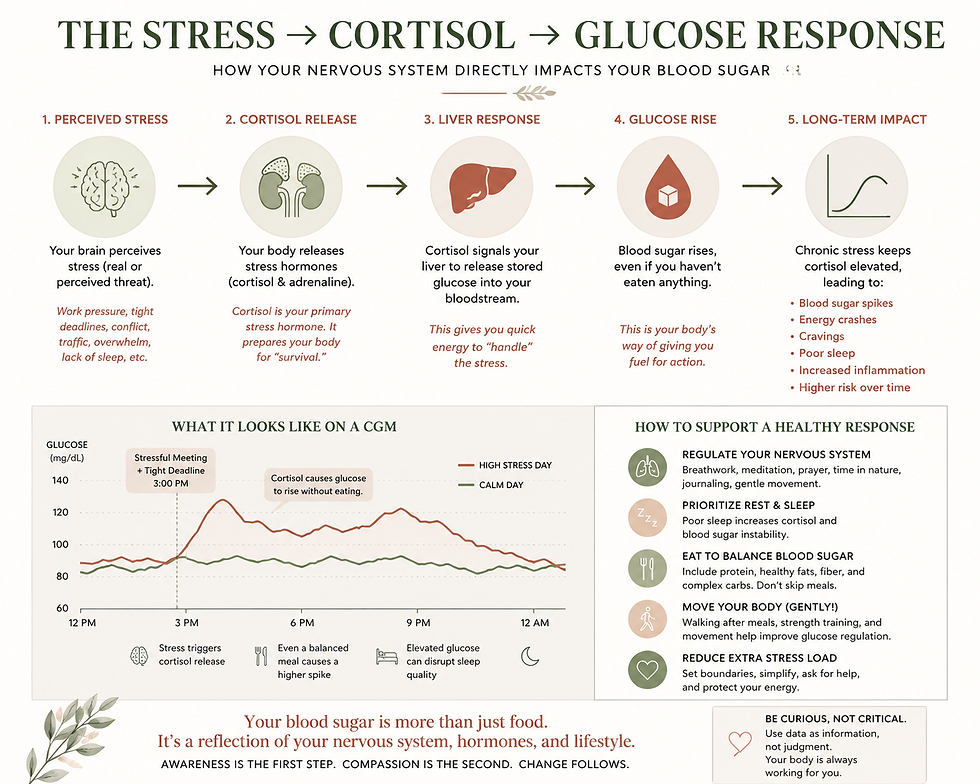
Blood sugar is not just influenced by food. Our nervous system, stress levels, sleep quality, emotions, exercise, and overall sense of safety all play a major role in how glucose behaves throughout the day.
When the brain perceives stress, whether mental/emotional (like a difficult conversation, rushing between obligations, emotional overwhelm, chronic mental load) or physical (poor sleep, overtraining, skipping meals, or even underlying systemic inflammation) the body releases stress hormones like cortisol and adrenaline. These hormones signal the liver to release stored glucose into the bloodstream to prepare the body for action and survival.
In other words: your blood sugar can rise even if you haven’t eaten anything.
This graphic illustrates that stress → cortisol → glucose pathway and how chronic nervous system activation play a huge role.
What I find especially important is that many people assume glucose spikes are only about “bad food choices,” when in reality the body is constantly responding to the environment around us and within us. It also showcases how food can either add to our stress response OR help to regulate that stress response.
This is one reason I love using CGMs through a mind-body and nervous-system lens rather than a perfectionistic or restrictive one. The goal is not to obsess over every number.
When we begin to see how stress physiology impacts our bodies in real time, we can start approaching health with more compassion, curiosity, and nervous system support, instead of shame or self-criticism (which honestly makes the situation worse).
I'm in the season of taking care of young children, managing work, taking care of a shifting body, and dealing with my own nervous system healing. One thing that was apparent was that eating while dysregulated (AKA, my child finding his screeching voice), greatly impacted my glucose patterns. I could eat a meal prepped breakfast (so the same meal) and see different responses depending on the day and the state of my nervous system.
I also saw how much sleep disruptions contributed to my activated system, which, was a hard reality considering it's simply a phase of life I'm working to get through.
But the biggest thing is that, while I can't fully control the sleep situation, it did show me what kind of eating and lifestyle pieces helped my body feel more regulated. I pride myself on being a resilient person and.... I also understand that the nervous system is a powerful piece to pay attention to. That, over time, neglecting this system ultimately leads to illness, disease, and feeling stuck in survival mode. I'm so thankful to this experiment and to reconnect to what is going on behind the scenes of life.
We get so busy and try to do all the things but sometimes a new lens is what we truly need to get re-embodied and pay attention to what the body truly needs.
Important Things People Should Know
CGMs Are Not Perfect
Readings can occasionally lag behind blood glucose or fluctuate, especially early in wear. Sometimes the sensor can get laid on while sleeping, and will lose data (but this is fairly obvious, when you look at the data - you won't get a high glucose reading when this happens, it will just look like the sensor bottomed out until you move position).
Additionally, the glucose readings may not match number by number, what is going on in your blood. I compared my CGM data to my finger prick data at home when looking at my fasting numbers and it's been shown to be off at times.
Time | CGM | Finger Prick | Difference |
6:24 AM | 104 mg/dL | 118 mg/dL | 14 mg/dL |
6:45 AM | 108 mg/dL | 105 mg/dL | 3 mg/dL |
7:07 AM | 122 mg/dL | 119 mg/dL | 3 mg/dL |
7:22 AM | 113 mg/dL | 137 mg/dL | 24 mg/dL |
7:42 AM | 94 mg/dL | 92 mg/dL | 2 mg/dL |
8:02 AM | 87 mg/dL | 90 mg/dL | 3 mg/dL |
HOWEVER CGMs aren't for tracking your total glucose - they are for tracking patterns over time and noticing where things move compared to your baseline. Due to the lag time of the CGM and the fact that it is measuring the glucose interstitial fluid, and not your blood, there will be some differences.
It is still 100% worth it to get your blood work looked at including your fasting glucose, HbA1c, and fasting insulin periodically to see how your blood sugar and insulin sensitivity is doing overall.
AND the CGM can still give us insight into your body function and reactions in the day to day. This serves as a reminder that we're not chasing numbers, we're chasing patterns.
Things I Encourage Clients to Track
I encourage clients to track:
meals
stress levels
sleep quality
mood
exercise
caffeine
hunger/fullness
menstrual cycle
symptoms (brain fog, shakiness, fatigue, anxiety)
The magic often happens when people connect their physiological data with their lived experience. This is important.
Who Might Benefit From Wearing a CGM?
People experiencing:
energy crashes
burnout
chronic stress
emotional eating
cravings
sleep disruption
anxiety
hormone imbalances
metabolic concerns
curiosity about body awareness
CGMs may also help highly active individuals better understand fueling and recovery.
Final Thoughts
The biggest thing I’ve learned from wearing a CGM is this:
Our bodies are constantly communicating with us.
Blood sugar is not simply about willpower or “good” vs “bad” foods. It’s deeply connected to:
stress
nervous system state
sleep
nourishment
movement
safety
recovery
and overall resilience.
For many people, CGMs can become a tool for awareness rather than control.
And in a culture that often encourages us to disconnect from our bodies, that awareness can be incredibly powerful.
Interested in Exploring CGM Insights?
At HartsSpace Mental Health & Nutrition, we offer:
CGM guidance sessions
personalized interpretation
functional nutrition support
nervous system-focused wellness coaching
Comments